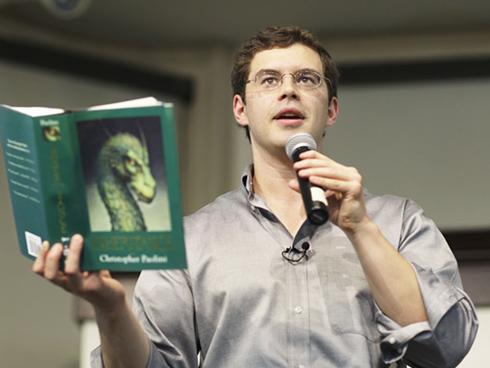
I warn you. This is not my typical interview because Cody May is not your typical writer. I was at the Colorado Teen Lit Fest and I met Cody, hawking his book, and we chatted. He was a senior in high school. Yes, still in high school with a book out there. Dang.

"If crime is merciless, justice must be too."
This is me. Impressed. Pinch me.
But wait. Cody May ain’t writing about pining werewolves or sparkly vampires. He’s writing about reality, crime, violence, pushing to make the world a better place. Hey, sounds like my book! (Must. Not. Self-Promote. During. Interview.) Yes, similar to my book, but Cody has a gritty vigilante in Pentalogy of the Becoming: Book One: Hale. Hard to the core, bro. Cody May is a warrior. As you will see.
So he agreed to an interview and we talked and this is a little of what we talked about.
Aaron: When I was a teen, I hated calling myself a teen. Even now, I don’t like the word. It’s so dismissive. Young Adult is better. But we need a better word. I know, I’ll make up my own word. Titeens. Like Titans, only, teens. Do you call yourself a teen?
Cody: I hold no shame in being identified as a teen. At least not by the word’s traditional definition. Most modernly, teenagers have become more identified by their reputation, rather than their literal age. Although I have tried hard to transcend the teenager’s common reputation, I am still, by age, a teen. Excuse me, a titeen.
Aaron: I’m a fragile sort, Cody. You did something it took me 20 years of angst to do, namely, get a book out into the world. Were you nervous or afraid when you were writing and trying to get published? If so, how did you overcome the fear?
Cody: The only thing that struck fear into the idea of publishing my work to a mere limitless audience was the worry of judgment. But, to overcome that worry, I had my publisher print the first copies of HALE unedited, so my first buyers from websites will possess the unedited manuscript. Doing so allowed me to understand that readers must look beyond the specs of flaw and appreciate the whole of merit.
Aaron: The life of the modern day titeen is busy, busy, busy. When did you find the time to write the book?
Cody: I didn’t find the time, but if you must ask, I wrote whenever I could. At first I wrote in the gaps of my free-time, but soon I realized I had to want success more than I wanted an A+ in school or a surplus of time to spare.
Aaron: Um, not to bust you, but did you write any of it during school, when you were supposed to be sponging up the wisdom of the ancients?
Cody: Of course!—I write huge chunks of my manuscripts in school every day! Although, I have never been punished for doing so—my teachers have learned to appreciate it.
Aaron: When we talked, you said you were focused on getting published before graduating? Why was that a motivator?
Cody: Two reasons. I knew that if I could write and publish a book as a student in high school, I could do it effortlessly as a paying job. And second, high school is a very contained community, allowing me to draw attention and to network, utilizing all the sources available.
Aaron: It seems like all books these days have a little of the paranormal in them, and I figured you’d have a vampire, fallen angel, telepath, telekinetic, or clairvoyant, but nope, no real paranormal aspects other than a “re-birth.” Did you consciously decide to avoid the paranormal?
Cody: Although fictitious superheroes and vigilantes equipped with paranormal or occult powers can be entertaining, it is hard for viewers and audiences to relate or bond with the characters on a human level. In Pentalogy of the Becoming, I wanted to express the reality of the unreal—what one would actually become if they were to dedicate their lives to fighting crime so radically. Practically any reader of any book in Pentalogy of the Becoming can deeply relate and bond with the characters, replacing the face I describe with their own face.
Aaron: I think your cover art is wicked cool, tell us about the cover art!
Cody: The process of publishing (not to mention the eight months of writing) HALE was a two-year-long strife. And when the time came to finally release it, I wanted its face to be more than a cover. With that in mind, I turned to my girlfriend (Kimberly Waters) and offered the proposition of her creating the cover. With much enthusiasm, she accepted the offer!—and thus, the cover for HALE.
And although it appears to be a simple cover, it holds several meanings, motifs and symbols from within the book itself. Kim applied an outlandish amount of detail in the cover, but as it printed, much of those details were lost. Still, though, the cover is a beautiful and precise expression of the book’s theme, premise and feel.
Aaron: Okay, Hale is book one in a pentalogy – what is your vision for the five books?
Cody: The name says it all: Pentalogy of the Becoming. This five-book, two million-word series is the becoming of an entire world, an entire society I will create throughout the rest of my writing career. The pentalogy is a slope leading to the formation of Everhood—a union of vigilantes fighting against their society’s most infamous criminals and crimes. In the four books leading to the massive conclusion, four major vigilantes are introduced, and together they form the union of Everhood, which will forever be the driving force for my future works.
My hope for this pentalogy is to make way for an entire world that will revolutionize the shape of the ‘superhero.’ People need inspiration, and I firmly believe that inspiration will not come from flying men in spandex. People must be exposed to raw plots and characters no different than themselves, whether they know it or not.
Aaron: If our job as writers is to share our sacred stories with the world, why choose this story to spend your minutes on? It’s a gritty crime thriller with comic book vigilantes without the superpowered ink or the comic. It’s hardcore. What led you to write such a book?
Cody: My job as a writer is to immortalize the thoughts and emotions every human upon this earth faces. Sadly, I am not alone when I say that I have been exposed to the brutality of crime from a young age. And for the first, comprehendible years of my life, I have not been part of a world that values morals more than it does cocaine, murder, greed and thievery. Writing such a reflective, gritty, dark and raw book exposes readers to the truth of our society while simultaneously offering a role to them—a role aside the common people who have allowed our society to fail.
The characters in every book are as human as any other. None have been given God-like powers, and none are equipped with omniscient abilities. They have been scarred, but refuse to be passive in the fight between good and evil—a fight that morality is so helplessly losing.
The four vigilantes I primarily introduce encapsulate all traits of all people: Hale is a merciless being of anger (an emotion we all experience), Dalion is a man of sadness and pain (a sensation we all dread), Muse is a common man of many (we are all the same—flesh and blood), and Red is an idea of objectivity—the knowing that morality can return to its feet. Thus, Everhood is not one, but all.
Pentalogy of the Becoming leaves space for readers to agree or disagree with a hero, to clinch their teeth at the scenes portrayed, and to develop their own perception of morality and how to fight the crime that will continue spreading like a mold if we refuse to stand against.
Cody’s publisher.
Buy Cody’s book on Amazon
Cody’s Facebook fan page
Thank you, Cody! For all you angels and vigilantes out there, let’s make the world a better place today.