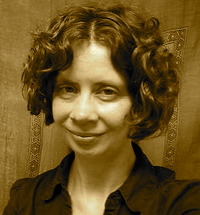
 This has been the fortnight of Linda Rohrbough. I blogged about her last week, we talked on the phone, and now the interview. I can’t say enough about what Linda Rohrbough has done for me. I am gushing. Because if you’ve met Linda Rohrbough, you know what a dynamo she is, how kind, how giving, how smart, how funny, how incredible. If you haven’t met Linda Rohrbough, and you are a writer, you will meet her. Because she is ubiquitous. Omnipresent. Omniscient. Eternal. Yeah, Linda Rohrbough is an incarnation of Vishnu. Is that blasphemous? I don’t care. I am now going to pour yak’s milk on her effigy and burn clarified butter in her name. Okay, that is blasphemous.
Linda Rohrbough has been writing since 1989, and has more than 5,000 articles and seven books to her credit along with national awards for her fiction and non-fiction. New York Times #1 bestselling author Debbie Macomber said about Linda’s new novel: “This is fast-paced, thrilling, edge-of-the-seat reading. The Prophetess One: At Risk had me flipping the pages and holding my breath.” The Prophetess One: At Risk recently won two national awards: the 2011 Global eBook Award and the 2011 Millennium Star Publishing Award. An iPhone App of her popular “Pitch Your Book” workshop is available in the Apple iTunes store. Visit her website: www.LindaRohrbough.us.
Now, Linda has been in the publishing game for a long time. But fiction, well, her first book, The Prophetess One: At Risk, came out last year. It’s a thriller, yo, not supernatural, just a thriller, but it’s been given awards and it’s been given praise, and here we are, to talk about it.
Here is the link to Amazon, but don’t go there yet. No, because Linda is going to tell you all about her book.
Aaron: Talking books is talking in pitches. And Linda Rohrbough does a life-changing pitch session, and no, I am not using hyperbole. There has been zero hyperbole in this whole darn blog so far. Um, that might have been hyperbole there. Anyway, so, Linda, what is your pitch for The Prophetess?
Linda: Let me add here, before I get started, that Aaron is fun to read in print. But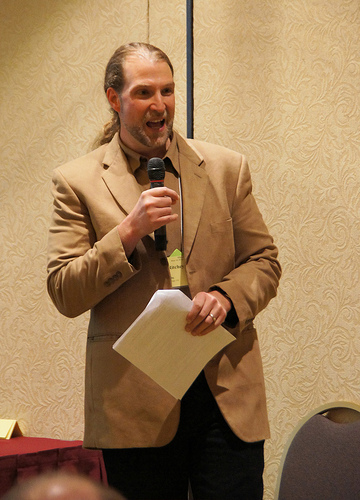 when he does his hyperbole in person, he does it with his pony-tailed, tongue-in-cheek manner that charms a crowd in a fresh way. I thought a group of writers listening to him speak at a conference last year were going to fall out of their seats they were laughing so hard. His delivery is half the fun. So if you get a chance to hear him in person, take it. Now on to my pitch . . .
In a quiet Kansas college town, a very pregnant computer programmer uncovers gifts from God that lead her across middle-eastern terrorists who are training lost teenage boys to be assassins. She learns that not only does her unborn child need her, but he needs her husband, too. And the theme of the book is, “Men are important in the lives of children.”
Aaron: Another pitching question, I ain’t done yet. Like the bio said, you have a pitching app even. Okay, let’s say you were approached by a biker gang, leather, chains, tattoos of “Cuz my mama didn’t love me” on their arms. And they say, “Writer, eh, whatcher book about?” How would you pitch to them? In other words, does your pitch change given your audience? How so? Give examples?
Linda: It does. If I’m talking to women, I emphasize the paranormal aspects. That’s what you and I as writers call it, but the average Joe calls it that knowing in your gut. So I’d start the pitch by asking, “Have you ever had a feeling you just couldn’t shake that something bad was going to happen?” They always nod yes. “So does my heroine in The Prophetess.” Then I launch into my pitch. But I pause at points to give them a chance to respond, which isn’t usually much – a nod, a “wow,” or some acknowledgement. Because I want to be having a conversation, not a monologue.
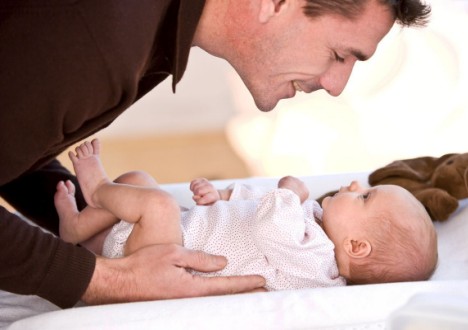
Now in the case of your biker dude, men, even biker dudes, are taken by the idea that the books’ theme is men are important in the lives of children. In fact, I’ve had men take the book away from their wives and hog it until they’re finished – just because of that single statement. Men know they’ve been ousted from the lives of children and they instinctively want to know why a woman would say that and how it plays out in the novel.
 Aaron: And yeah, question #3, still pitching. If you were going to do a super bad pitch of your book, what would that sound like? Give me the awkward, newbie, writer pitch.
Linda: Well, uh, there’s Anna and she met Jack in California and they got like married real fast. And she’s real uncomfortable being pregnant so she can’t wait to get out of Kansas to some beach town when Jack graduates. Only they don’t have any money hardly, and really, he’s not going to make enough to get them there. But she has her dreams – all these fish in her apartment, especially one named Harold, a beta that she keeps in a bowl next to her bed. And now she’s transplanted to this super miserable hot little town where she works as a programmer in the basement of the only hospital. (If anyone is still listening right now, and they probably wouldn’t be, but a newbie would go on with) They go to this couple’s baby shower where Anna doesn’t know anyone and Jack says don’t say any of that weird stuff you’ve been saying. And she agrees, only when they get in there she meets the pastor’s wife and another gal and . . .(okay I’m going to put you out of your misery now and quit).
I call this, “Telling Braveheart.” In my courses, I talk about the time I was riding in the car with my brother from Estes Park to Morrison and he’d just seen the movie Braveheart. So in the awkwardness of the car ride, he decides to tell me the entire movie, start to finish. I thought it would never end. What is it about someone telling you a movie? I still to this day don’t understand anything he told me, even though I have since seen Braveheart. Well, that’s what new writers do. They “tell Braveheart” – try to pitch their story by telling the whole thing, beginning to end, instead of synopsizing the salient points in a manner a listener can understand and follow. Now in defense of newbees, it’s a completely different set of skills to write a book than to talk about a book. Which is why I developed my “Pitch Your Book” workshop in the first place.
Aaron: Now, as we all know, it takes awhile to write a book. The Prophetess has lots of technology in it. I mean, not tons. It’s not written in binary or C++ or anything. But as you revised your book, did you have to update it because of the technology? Did that change key plot points?
Linda: Yep, absolutely. I began the original manuscript over a dozen years ago, and back then every dirt poor college kid didn’t have a cell phone. Very few people had them. So when I got an agent and then an editor interested in the book, I realized I was going to have to address this problem. Because no matter how poor a college kid is these days, there’s a cell phone involved. And a married couple who are as technically literate as these two would each have their own. But it’s a major component of the story that they don’t have phone access of any kind for a period of time. So how to accomplish that? Then I was hanging out with my twenty-something daughter and she lost her cell phone one week and then dropped and broke it the next. And I thought, that’s it. These kids are always breaking and losing their phones. All I have to do is have Jack break his phone, borrow Anna’s and then drop and break hers. Easy as pie. And believable.
Aaron: Okay, my day job is with McKesson, the greatest company on the planet, and as all you nurses out there know, McKesson is huge in the healthcare I.T. department. Let’s say I’m hiring. Let’s say I’m smoking a big cigar, in my corner office, looking for a new recruit. Do you think your heroine, Anna McClintock, would do well in a job interview? What would she say? Would I hire her? What could she do for me? And no, there was no innuendo in that question. Don’t be naughty. The erotica interview was last week.
Linda: Anna ain’t that kind of gal, Mr. Ritchey. (And actually, anyone who knows you knows you ain’t that kind of guy, either.) Anna would ask questions. She would ask what you see the perfect technology person in your organization would bring to the table. She’s too smart to walk into your office and offer to change the operation. She knows you like the operation the way it is, that you’re proud of it, and with good reason. She’ll be smart enough to point to some of the things she’s seen that are impressive to her. But she’d have some ideas for how she could serve your team to get the results you want. Which is why, in the book, she’s uncomfortable with the changes she is proposing to the hospital’s website, but she knows they need to happen. So she goes out on a limb. And you know what happens.
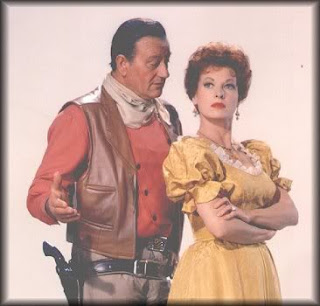 Aaron: How did you come up with the name of Anna McClintock? Are you a John Wayne fan? Um, ‘cause there was the movie, McClintock. I’m showing my age.
Linda: To be frank, I just made it up. Ran names through my head and through baby naming books until I found what felt right. I had the character before I had the name. She needed a short first name. And I like those tough sounding “Mc” start names. Anna is tough. So is Jack, for that matter.
Aaron: I must say, what really grabbed me in the first act of your book was how you portrayed your heroine Anna, a young pregnant woman, newly married, struggling to balance the emotions of her husband, the physical stress of pregnancy, and her career. Not to get too personal or serious, but what stylistic choices did you make to flesh out your heroine?
Linda: Stylistic choices. Well, I’ve been pregnant in Kansas while my husband was an engineering student. And I’ve lived in the married student housing. Not at KSU, but at Kansas State, which is not far down the road. I think, though, with any character, you have to slide down inside their skin and look out at the world from their eyeballs. And I did that with all my characters. Like what would it would feel like to be Theo, watching Dr. Moody from the side of the ER? What did the air feel like, the floors, the chairs, what did it smell like? What would it be like to be Dr. Moody, making calls from his desk with the photo of his son within reach? Reliving the tragedy in his life.
Aaron: Now to get a little more serious, being a native Coloradoan exiled in North Carolina (there are worse places to be exiled), did the Columbine tragedy play into your novel in any way? It seems to me, some of the characters and some of the feel of the book reminded me of young, troubled minds, slipping into madness.
Linda: You know we lost my husband’s nephew, Daniel Rohrbough, at Columbine. And I was there right afterward. From the call that evening, after watching the Columbine shooting on the news and thinking I grew up with people who live right there – I’ve been in that neighborhood, walked the path around Johnson Reservoir and through Clements Park, both of which are right behind the school. To the call that evening from my husband’s parents and his brother who said Danny is missing but he would never scare his mother like this, so they assumed the worst. Asked us to come. At the time we lived in Dallas. Boarding a plane with my two kids feeling kind of numb and I wondered what in the world I could contribute to this insane set of events. Then later at the funeral home staring at this young man, I realized how much he looked like my husband at the same age (I’d met my husband when I was fourteen and he was fifteen). I had to leave the viewing room.
Then there were the odd things that my journalist mind just couldn’t let go of. Like how Colin Powell was at the memorial service the next day, on the platform between Amy Grant and Phil Driscoll, in full military dress. But he was never announced and he never spoke.
I followed the news reports for years afterward. How the Columbine shooters said theirs would be the first and best of many school shootings and wondering how could they know that. Noting that they low-level formatted the hard disk drive of their computer before they went out to shoot, as did a number of other school shooters that came along later. But they left a website and pages of letters and documentation, so what was it they didn’t want anyone to find?
This article, run by the Austin-American Statesman, says more about what I found and the connection between Al-Qaeda and school shootings. My heart breaks for those folks in Ohio. But that this is exactly what I’m talking about. I believe it’s preventable when we get educated on what to look for. I’m sure the authorities are going to find out T.J. Lane had lots of alone time on the internet. And I wouldn’t be surprised at all to learn he started a low-level format of the computer’s hard disk drive before he went on his shooting spree. This is a pattern. And it’s about with lost boys who are looking for male role models and are finding them in the wrong places.
Aaron: Uh, well, since we’re getting serious and personal, might we go a little deeper? How did your personal life affect the themes in The Prophetess? So, what are the themes in the book? And why do you think I’m asking questions backwards? Have I switched to Yoda-mode? Your book, you will tell me the themes of, please. Young Jedi. A little humor.
Linda: I’ve already mentioned all the research I did that put all this data in my head. And there were the “what if’s?” I wanted to have someone very helpless to face off with the monsters, that weren’t really monsters but wounded people trying to cope. And how we get to choose what to do with the wounds life hands us. And maybe there is a purpose when it looks like insanity all around. But it was the helplessness that appealed to me. Frankly, I never felt more helpless than when I was pregnant. Plus a pregnant person is custodian of a life and that’s a strength in weakness kind of thing. That felt important too.
Aaron: If there was one emotion you wanted your readers to take away, what would it be? For me, after they read my book, I would want them to feel the uncontrollable urge to buy a dozen more copies to give to their friends. But that’s me. I’m assuming you have less mercenary wishes for your readers as they read those last, few important sentences.
Linda: I was not thinking about an uncontrollable urge to buy more copies. (You are funny.) I did want to take my readers into a world with fast-paced action and have them experience things that would stick with them. For example, it’s an important question to ask did we throw out the baby with the bathwater when men left the lives of their children for the work-a-day world? My husband and I had sort of an unspoken agreement that I would raise the kids while he was off in the corporate world fighting the good fight long hours every day and on weekends and I think that hurt our kids. Or, for example, when we allowed the salaries of teachers relative to the economic conditions to stagnate so a man cannot be a teacher and still comfortably raise a family. I do think it’s important to take another look at what’s going on around us and realize we can make different choices. And to ask ourselves is this what we really want?
By-the-way, readers, you should know Aaron is a devoted dad to his two beautiful daughters. He’s there every day, involved, reading bedtime stories, helping his oldest daughter with her writing (yes, she’s becoming a budding writer as well), playing with them and teaching them shoulder-to-shoulder with his lovely and smart wife Laura. And yet, he does the corporate thing. And is a writer in his own right. He’s a great dad role model.
Aaron: Aw, shucks. Well, the love-fest must now come to an end. Thank you so much, Linda, for the interview! And folks close to Colorado Springs, Linda will be at the Pikes Peak Writers Conference in April, doing her pitching workshop. Her bad example had me laughing out loud! People at the Starbucks glared at me, but let them glare, that’s what I say.
Thanks again, Linda!

Follow Linda on twitter.
Like her on Facebook.
Linda’s Books.