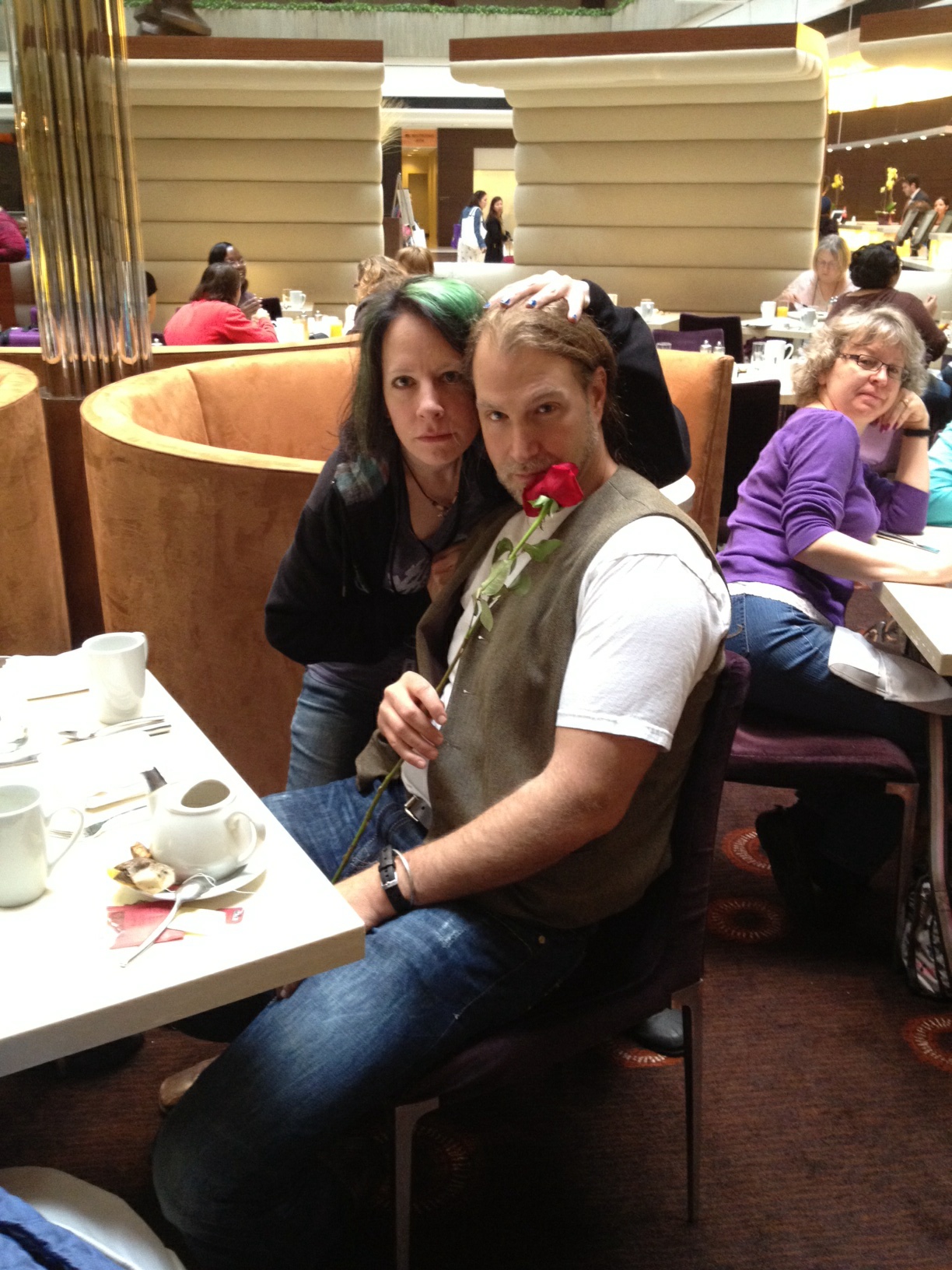
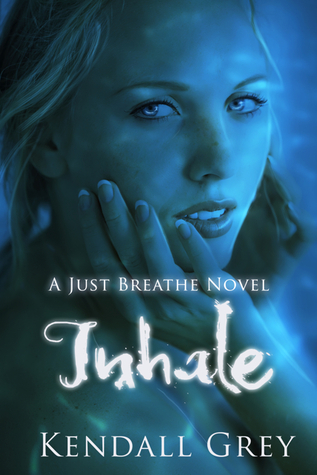
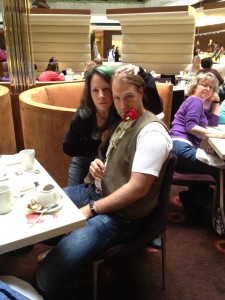
 I met Kendall Grey at Romantic Times Book Lover’s convention in Chicago and our first conversation was all about how she was hardcore cynical and dark, and she could out-negative me. Oh, Ms. Grey, you don’t wanna go there. So I was ready to do battle, until she revealed the softer side. She talked about her books, Inhale, Exhale, and Just Breathe, and she got a little teary. Hardcore cynical, with a heart soft and golden. Right then, I knew I liked this Kendall Grey. We bonded, and when we are together, we are Kendaaron. In Hollywood, we’re kind of a big deal.
So we talked and, I asked her if…no, no, no, wait for the interview! First more intro stuff. Her debut novel, Inhale, is out now. Exhale is coming soon. And Just Breathe on the horizon. Squint, you can see it.
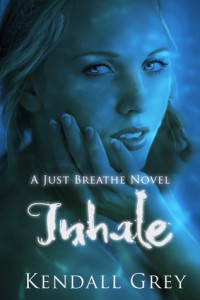 And check out this very delicious bio from her website all linked up here: Kendall Grey is a whale educator and urban fantasy writer. She lives near Atlanta, Georgia with her ghost husband, a random rainbow, a gossamer-winged fairy, a wild imp, and a ferocious, miniature, long-haired Dachshund who keeps them all in line. INHALE is the first book in the “Just Breathe” trilogy.
Whales, man, it’s all about the whales. Or the sex. Or both. Here is the interview.
Aaron: When we talked, you said you kept going to Gloucester, Massachusetts for the whales. Como? Come again? Whales in Massachusetts? Help me, Rhonda. How did those east coast whales, and other huge ocean mammals around the globe, inspire you, the titles of the books, et cetera?
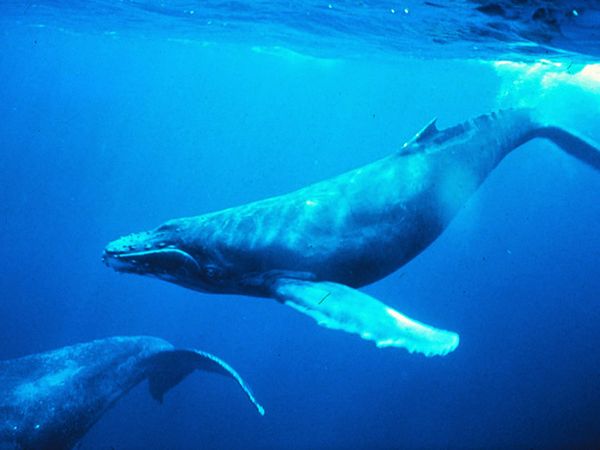
Kendall: I’ve been a whale fanatic for years. While I was on a whale watching trip in 2008, I picked up Stephenie Meyer’s Twilight. I loved the heck out of that story and thought, “I could write a book.” Of course, the heroine had to be a whale biologist, because, like, DUH! Since I know a few things about whales, the subject matter was a no brainer.
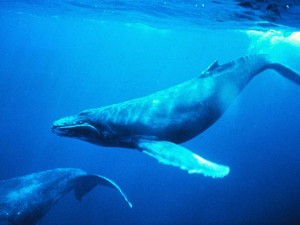
The titles of the books in the trilogy are inspired by the whales too. One of the most amazing things about these animals is the immensity of their breaths. If you’ve ever heard one blow up close, the sound is freaking HUGE! I still get chills when I hear that mighty breath rushing out at 200 miles per hour. They expel and refill lungs the size of small cars in a matter of a couple seconds. Did you know they exchange about 85% of their oxygen in one breath? We pathetic humans only average about 15 – 20%. Next to whales, we are hedgehog poop.
Aaron: So you are close personal friends with Stephenie Meyer. Well, you read her books. In a way, they inspired the book as much as the whales. What is one question you would ask Stephenie Meyer if you met her?
Kendall: What the hell were you thinking when you wrote Breaking Dawn? Hahahaha! I loved the first three books, but the last one went off on a total tangent for me. Sorry, Twilight fans!
Aaron: Now, your books have some erotic coupling, the characters use “colorful” language, and yet, people have thought your books are YA. Let’s be clear. Your books are for adults. Not like adult-bookstore adults, but yeah, you get me. Could you re-write Inhale as a YA novel? What would change? What would you keep? Can you write sentences without “colorful” language, like tumescent?
Kendall: Erm, no, I don’t think I could rewrite the books as YA because they’re about ADULTS. The heroine is 32 years old. She’s a professional woman with a doctorate degree in cetacean biology. I suppose I could pull a Doogie Howser and make her a brilliant teenage prodigy or some crap, but there’s enough willing suspension of disbelief already rippling through this trilogy No reason to make it completely unbelievable.
Aaron: Inhale started out at a hefty 215,000 words, and yet you queried. What kind of reaction did you get with that doorstop size of a book?
Kendall: A hell of a lot of form rejections. HA! One agent was kind enough to write a personal note that basically said, “Just so you know, 215K is more like three books, not one.” I was clueless. I just wrote the book I wanted to read. I never investigated things like word counts or goal, motivation, and conflict. I was too busy having fun to mess with all that boring technical stuff. 🙂
Aaron: Can you give us a little peek-a-boo as to what your query was for Inhale? Maybe like a pitch. A little pitch. For a 215K book, you should get at least 3500 words to pitch your book.
Kendall: Honestly, I don’t even remember what I wrote in the queries. I think I deleted them all. They were as bad as the original book. I prefer to repress those bad memories.
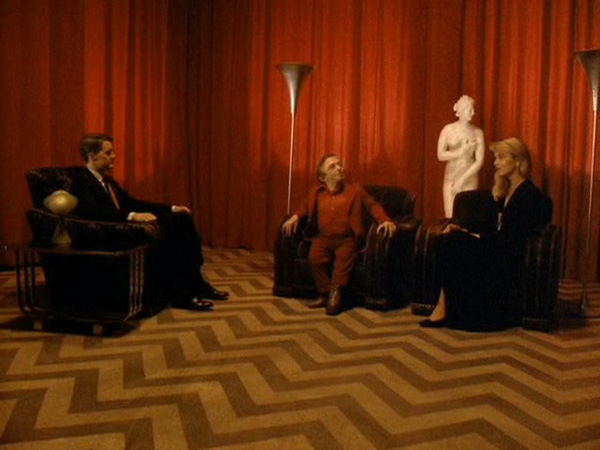
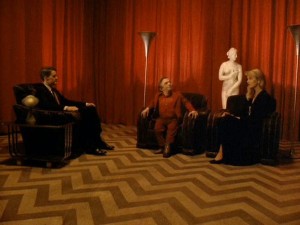 Aaron: In Inhale, dreams are important. Did your own dreams color the writing of these books? Do you have freaky dreams, like in David Lynch’s Twin Peaks, with giants, midgets, people who talk backwards? Am I in your dreams?
Kendall: Gavin, the hero in the trilogy, actually did come to me in a dream, so yeah, they’ve played a role. I had this image of what he looked like based on that dream, and I never let go of it. He also ate buttloads of creamed corn in the dream, so YES, Twin Peaks had a dominant role. As for your last question, of course I dream about you. Every night. You’re my better half, and your mad words inspire me.
Aaron: When we talked, in Exhale, the sequel, your favorite scene in the book was with your villain, the villain that everyone loves. Why do you think people are drawn to your evil guy?
Kendall: I think readers love Sinnder because he’s so mysterious, and you can’t tell what his true motives are. He does all the wrong things for all the right reasons. He’s Trouble with a capital T, yet you get the sense there’s a LOT more to him than meets the eye. SPOILER ALERT! –> There is a lot more to him than meets the eye.
Aaron: You voice your opinions readily on the internet. I mean, right now, you are composing tweets in your head about this interview and how much you hate me. No, be honest. I can feel the hate. Do you ever wish you were different? Oh, I don’t know, more genteel, Pride-and-Prejudice-sweet, why, yes, Mr. Darcy, I would like more tea? Do you ever wish you had more Jane Bennett in you, or are you happy being all Elizabeth?
Kendall: I have nothing but sticky sweet adoration for your particular brand of badassery, so hush that self-deprecating mess right now. If you don’t, I’ll come after you with a switch and teach your booty a lesson.
I have no idea what those other words in your question mean. What is “Jane Bennett”? “Tea”? “Genteel”? Does. Not. Compute. The only thing I wish I could change about myself is the amphibious thinness of my writer skin. It needs at least 40 lashings from the aforementioned switch to build up some gnarly-thick calluses. Bring on the chips, dips, chains, and whips! Being loud and obnoxious is easy. Weathering bad reviews and people hating my words? I cry like a baby over that crap.
Aaron: Last question. You picked up a bestseller recently and it made you want to freakin’ puke. Tell us about the experience. You needn’t name names, but I found this part of our conversation interesting. Go through it, blow and blow. Countdown to a Kendall Grey rant…three…two…one…rant!
Kendall: The book is a New York Times bestseller. It’s sold gazillions of copies. As of this interview, it has 17,223 reviews on Goodreads with an average rating of 4.10. Several friends highly recommended it. The concept sounded awesome, so I tried it.
 The first chapter (and many others) was about 87% back story that I didn’t need, and ended with a totally lame hook that made me NOT want to read more. The heroine was a doe-eyed wet dishrag with the personality of the ingrown toenail sporting a grungy fungus on my left foot. The “hero” (I use the term very loosely) tried to kill her a couple of chapters in. What did she do? Why, she fell in instalove with him, of course! He stabbed the tree he’d cornered her against –stabbed it right next to her head, mind you–and all she could think was, “Oh my God, he’s BEAUTIFUL!” Seriously? Dude, he tried to KILL you! He threatened your blissfully naïve virgin flesh with a long, badass phallic sword! You were scared dookeyless two seconds ago, and now you’re ready to hand your virginity over to him? I sense some deep-seated psychological issues at play here.
As one cannot resist the lure of a good train wreck, I could not put the book down. I had to see just how bad it could get. The author lived up to my expectations. When I got to the sex scenes, I HOL-ed. By that, I mean HOWLED out loud. The author wrote pretty graphic sex (Awesome! Finally!) but then used words like “testicles” and “penis,” which would have been fine had I been reading a coroner’s technical manual, but a romance? Who thinks these words when they’re having wild, crazy sex? “Come on, baby. Slap your testicles against my thigh. Hubba hubba!” Really? And, despite those clinical man-part terms, she never used the word “vagina.” Can we say double standard? I don’t get it.
On top of the yawn-worthy storyline and the confused, wishy-washy excuses for characters, the author used gobs of –ly adverbs (her favorite was “instantly” – FML), passive verbs EVERYWHERE, head-hopping in the middle of a paragraph (then head-hopping back to the other POV in the next paragraph), almost ALL telling with very little showing, poorly constructed sentences with questionable word choice—basically, everything “They” tell writers not to do. I could teach a six-week long course on how NOT to write a novel based on this POS. I made extensive notes on my Kindle as I read. I’m thinking about sending them to the author’s editor. Maybe she could learn a thing or two.
Bottom line: the book had the same effect on me as a long, hearty swig from an expired bottle of syrup of ipecac. I’m not here to criticize anyone’s book choices, but if this is the caliber of writing New York’s “Gatekeepers” expect from their well-respected and highly paid authors, then half of my fellow low-life scum indie writers should be billionaires. Based on the ratings, I can only conclude that readers inexplicably enjoy the book and the series. Maybe it’s because most readers aren’t writers and don’t know what good writing is. If that’s the case, then why should we authors bother writing “correctly”? Why not just throw a bunch of mouth-breathing dullard characters into an ass-potato plot sack, shake and bake, and then spit out greasy, hairy mud pies for New York’s book devouring pleasure? I don’t do that because I tend to think of what I write as art, not the source of a potential retirement fund. Maybe that’s why I’m not making any money. At this stage, I picture myself retiring to an alluring Crack Alley low-rise with nothing to show for my efforts but a needle and spoon and a couple of crushed Triscuits in my shoes.
Whatever, New York. Get on with your bad self.
Kendall rant OVER! 😉
Thanks for hosting me on your blog, hot stuff. I can’t wait to catch up with you at RT next year so we can dazzle the masses again with our epic Kendaaron awesomeness.
Thank you, Kendall Grey. Best. Interview. Ever. Hilarious! And switches, man, switches.
Inhale on Amazon
Kendall on twitter
Facebook author page
Just Breathe Novels with book trailer
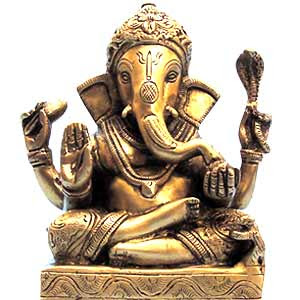 Be open to following directions. When the student is ready, the teacher will appear. Wouldn’t it be cool if you were writing and Ganesha appeared? How awesome would that be?