 Cindy Young-Turner lost a bet and was forced to let me interview her. Or she pulled the shortest straw. Or there was some diabolical deal that was made. (CYT: It was a dark and stormy night. I met the devil at the crossroads. He offered me the chance to be a brilliant guitar player or… do an interview with Aaron. Guess which one I picked?) I don’t know, but we chatted, and it was a delight!
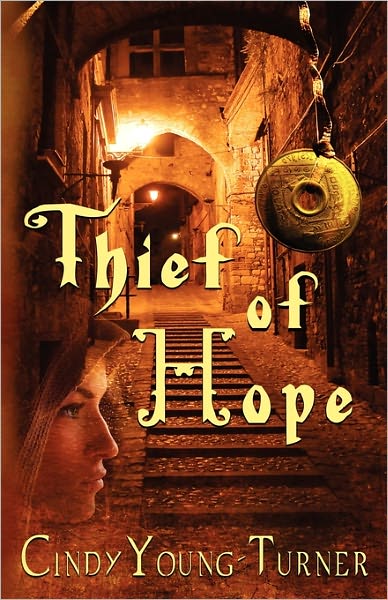
She is a writer’s writer. Lives in Maryland because that’s where cool folks live, and for a day job she works on proposals for health and development projects in developing nations across this big, blue marble where we live. And she writes and belongs to two, count ‘em, two critique groups. Her first novel, Thief of Hope, came out in May of 2011 from Crescent Moon Press.
What is Thief of Hope about? I’m glad you asked.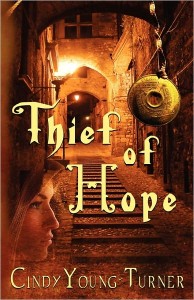
Sydney, a street urchin and pickpocket in the town of Last Hope, has managed to evade the oppressive Guild for years, but there is no escaping fate when she’s sentenced to death for associating with the resistance. After she’s rescued by a wizard, Sydney is forced to accept that magic–long outlawed throughout the Kingdom of Thanumor–still exists, and the Tuatha, a powerful faery folk, are much more than ancient myth and legend. When the wizard offers a chance to fight the Guild and bring Willem, bastard prince and champion of the Tuatha, to the throne, Sydney embraces the cause as a way to find her own redemption. But Sydney’s fear of the Guild, distrust of authority, and surprising connection to the Tuatha threaten Willem’s success. Can she untangle the strange threads that entwine her life not only to the fate of the kingdom, but also to Willem himself?
It’s fantasy time, m’lords and ladies. Polish off the swords, grab a spellbook or three, curl up with a Beholder, and let’s get to it.
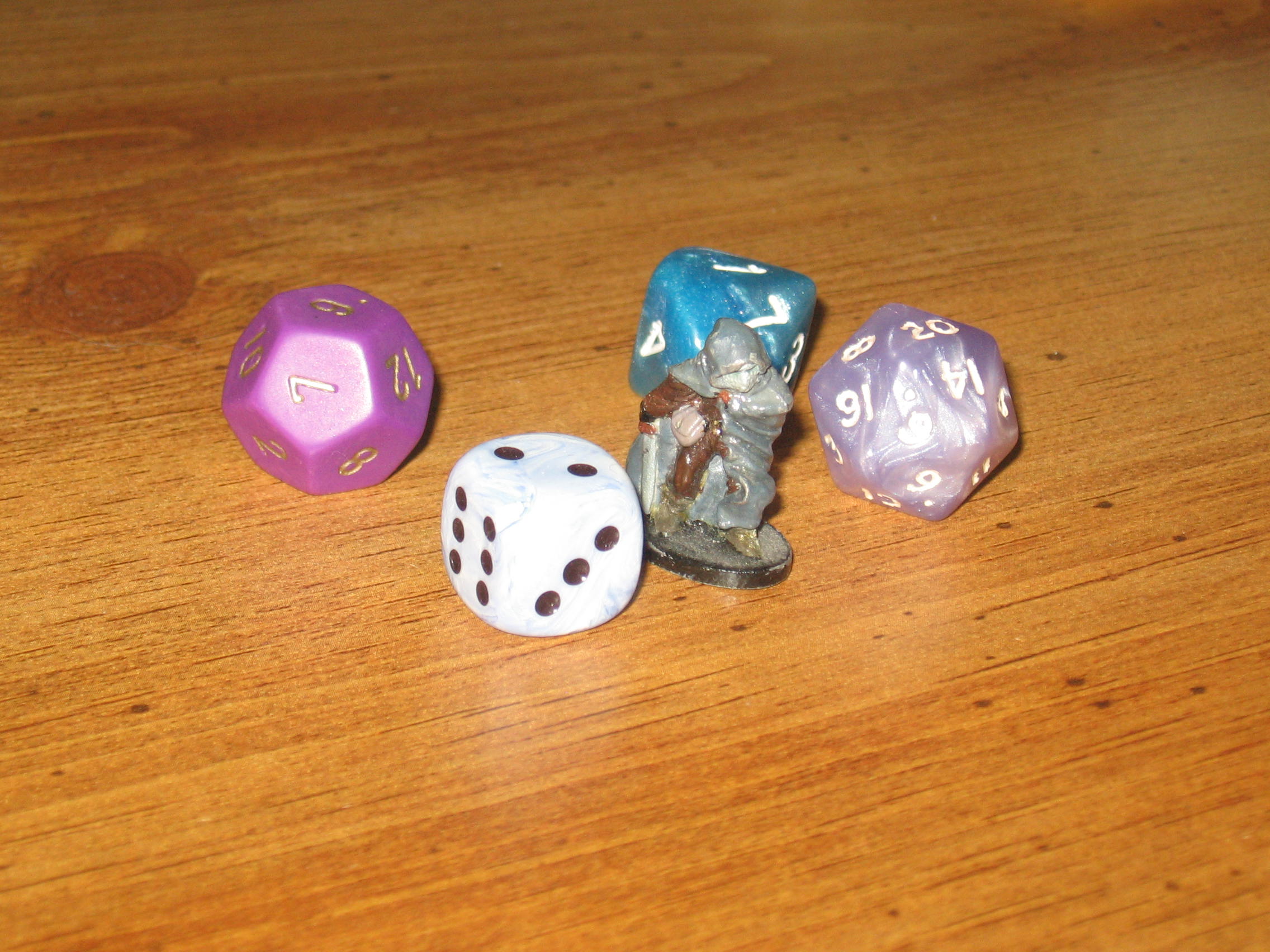
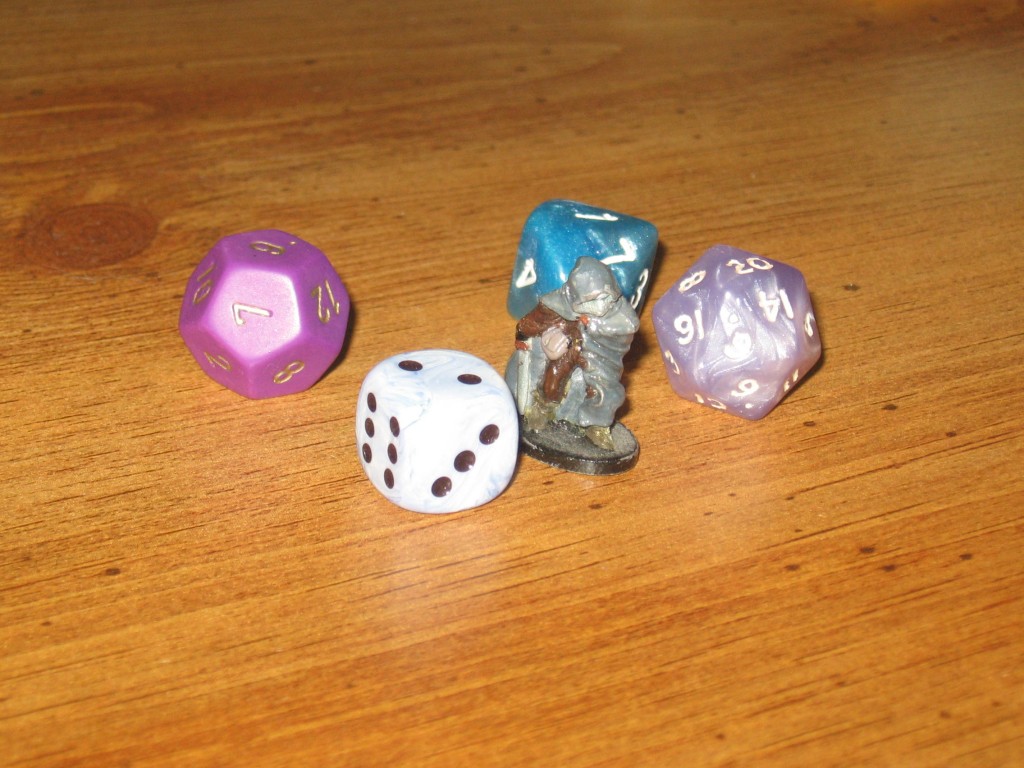
Aaron Michael Ritchey: Okay, when we chatted, we talked about Dungeons and Dragons. And boom, I figured this was as good an excuse as any for me to come out. To be open. I am a former gamer. A graph-paper gamer. Lead miniatures. Dodecahedron dice. Big Gulps and cheap pizza. Yes. I did it. I’m not proud of the countless hours I spent gaming, nor the role-play I did in grocery stores across Northern California, but there you have it. It’s out now. Good. Cindy, I think we need to embrace our history of fighting umber hulks and stirges ‘til four in the morning. The question, now, is this. How did your experiences as a gamer prepare you for the awesome task of writing a fantasy novel?
Cindy Young-Turner: You’ve twisted my arm. I’m coming out of the gaming basement with you. I began playing D&D in college. I’m not sure if that makes me more or less geeky. Saturday nights were spent with soda, pizza, powdered doughnuts, and slaying orcs and giants. I loved it. And it introduced me to fantasy. Honestly, I hadn’t read much fantasy until I went to college and my friends started giving me fantasy books to read (and lured me into the diabolical world of D&D). I was hooked. In fact, I’ll even admit here that the main character of Thief of Hope began as my very first D&D character. In some ways, role playing is a writer’s dream because you get to act out the part of a character. Um, isn’t it? Okay, I’m putting the gaming dice in the drawer now and backing away.
Aaron: I’m a morning gamer…er, writer. So for me, I have a time limit. I write until I have to go to work. As a night writer (not to be confused with David Hasselhoff, Knight Rider–nevermind), when do you call it quits? When do you shut off the computer when you don’t have any set time limits?
Cindy: I’m definitely a night owl. I’ve always been a night person. Being frantically busy, sadly I can’t quit my day job just yet, means I write when I can, and if I have to stay up to the wee hours of the morning, that’s what I do. When I was working on the final edits for my novel there was at least one time where I was literally falling asleep over my laptop. That’s a sign it’s time to call it a night. If I’m on a roll, though, sometimes I’ll just stay up another hour. The only problem is that with a three-year-old there’s no making up sleep like I used to be able to do. I’m getting old. Can’t do those all-nighters any more.
Aaron: What are the high fantasy elements of Thief of Hope? How J.R.R. is it? What are the low fantasy elements of your novel? How ghetto fabulous is it?
 Cindy: I wikipedia’d high fantasy vs. low fantasy to make sure I got it right. High fantasy is set in a made-up world (like Tolkien’s Lord of the Rings), so my novel falls into that category. On the other hand, it’s not the kind of fantasy with elves and dragons and unicorns. The town of Last Hope, where my heroine lives, is a dark, gritty place. Think inner-city Baltimore crossed with medieval Edinburgh. Thieves, prostitutes, drug addicts. So there’s a bit of real world realism, just translated to a fantasy realm. It’s not really the kind of place Frodo Baggins would stop in for a pint, although there are some decent parts of town as well as the slums where you’d better watch your back.
Aaron: Your day job is working on proposals for projects in developing countries regarding health and development. Do any of the aspects of your job filter into your novel? If so, what is an example?
Cindy: I think the aspects of my novel that might relate to my job are more just part of who I am. Self-empowerment, freedom, and fighting against oppression are important themes in the novel, and they are also things I’ve felt strongly about for a long time. It’s neat to be able to say that in some small way the work I support makes a difference in the world. I never intended to put those things into the novel, but somehow they crept in. And I like that. I hope it gives the story more depth and more relevance to issues we are dealing with in the world today.
Aaron: Favorite Dungeons and Dragons memory? Sorry, sorry, sorry. But do you have one? Last D&D question. I promise.
Cindy: You had to ask! There is one night in particular that comes to mind. A room of 30 or so hill giants. About 10 of us adventurers. We actually came up with an elaborate plan and everyone followed through. Which is amazing because if you’ve ever gamed with a group of people you know there’s always one who’s out there throwing fireballs or whatever at random. It’s the first and only time I’ve gamed until the sun came up. And the only time I drank six cokes in one night. My hands were actually shaking from the caffeine. But we kicked some hill giant butt and the battle became the stuff of legends. And I’m sure I sound like a total dork for gushing on about it.
Aaron: I too belong to two critique groups. How do you generally use them? For me, I try to have each group look at a different project. But now that Thief of Hope is out, and you are working on the sequel, what is your general practice? How do the two groups fit into your writing routine? If it’s too secret, lie. We’ll never know the difference.
Cindy: I can only focus on one project at a time, so both of my critique groups review the same thing for me. I get different feedback from each group, though. One is all genres (I’m the only fantasy writer) and the other is primarily SF/fantasy. Each group has a different vibe and gives me a different perspective. I tend to procrastinate a lot with my writing, so often I write in spurts before a deadline to send things to my groups for review (see the staying up ’til all hours question). I need something other than myself to keep me motivated. And with the first novel published, I have even more incentive to finish the sequel.
Aaron: Okay, Thief of Hope really was a labor of love. You’ve spent years and years working on it, and finally, it’s out there. Going forward, what lessons did you learn from writing that novel that will help you with the sequel?
Cindy: One important thing I learned is how to plot and create a story arc. You need a good story to begin with, but it also has to hang together. If only I could outline, but I’ve tried and it just doesn’t work for me. I have to write in order to find out where the story is going. I feel like I’m a much better writer than I was when I first started Thief of Hope, but you always need feedback and criticism so you can continue to improve.
Aaron: Your heroine, Sydney, starts out as a street urchin. If she were to come to your door, would you let her stay with you, like on your couch? Or would she be too scary?
Cindy: Hmm, that’s a tough one. I might take pity on her and let her have the couch, but only if she took a good long shower first. And I suppose I’d hide our valuables. Just in case. She is a thief, after all.
Aaron: Okay, now we all know that being novelist is a life filled with fame, fortune, money, offers of seductions, lots of seducing and money and leisure time. Okay, none of that is true. It’s a life of grueling, lonely work and missed sleep. If there was a drug that could cure the writer of this burden to write, would you take it? No more writing. No more of the desire to write. Would you take such a drug? Why or why not? And give us the juicy details.
Cindy: It’s tempting, but I don’t think I’d want that kind of drug. I do envy the non-writers out there, people who can come home from work and don’t have that creative monkey on their back saying write write write. But writing is so much a part of me that I don’t want to give it up. I’ve always told people I wanted to be an author when I grew up and being able to say I did it and followed my dream is the coolest thing. Now where’s my fame and fortune? LOL

Aaron: Last question. What if. What if the Tolkien estate came to you and asked you to write a new Middle Earth novel, would you do it? If so, what might such a book look like? Would it be more Tom Bombadil or more Shelob’s Lair?
Cindy: I. hate. spiders. With a passion. There was nothing more frightening than seeing Shelob on the big screen. I am partial to Tom Bombadil, though. I’d be deeply honored if Tolkien’s estate asked me to write a new Middle Earth novel but I don’t know if I’d feel up to the challenge. Tolkien fans can be rabid. These are people who can recite the genealogy of Middle Earth and can read and speak elvish. I haven’t even read the appendices of LOTR. But there are so many facets to Middle Earth that maybe I could find an obscure character to write about. And Peter Jackson, if you’re reading this, I have a great fantasy novel for your next movie project.
Thanks so much for putting me through the wringer, er, interviewing me on your blog! Now who’s up for fighting some trolls?
Give it up, ladies and gentlemen! A big round of applause! I had such a nice time with Cindy. And I love that her first published book comes from her experiences gaming. Bravo! It’s so sweet. Not the first, not the last, but still, so sweet. And for all you graph-paper gamers out there. Keep your swords sharp, your spellbooks dry, and check out Cindy’s website andThief of Hope on Amazon. And, and, and, you can purchase the print version of Thief of Hope on B&N. You lucky, lucky halflings.
 There are angels.
 Landon type of way. And before all you TV people get up in arms and barrage my website with comments, let me just say, I know Michael Landon did Highway to Heaven. Please. Do you think I went to prom or kissed a girl ever when I was in high school? No. I stayed at home, watching angel shows, and crying. Thanks so much for bringing up such painful memories.
 I was on my way to shave off all of my body hair and do drugs until I methed my heart out of my chest so I could slice that up, cook that up on a spoon, and inject my own heart back into my veins. Actually, that’s not true. I was fully clean and sober. I was going to eat a pound cake. First rejection is such drama.